

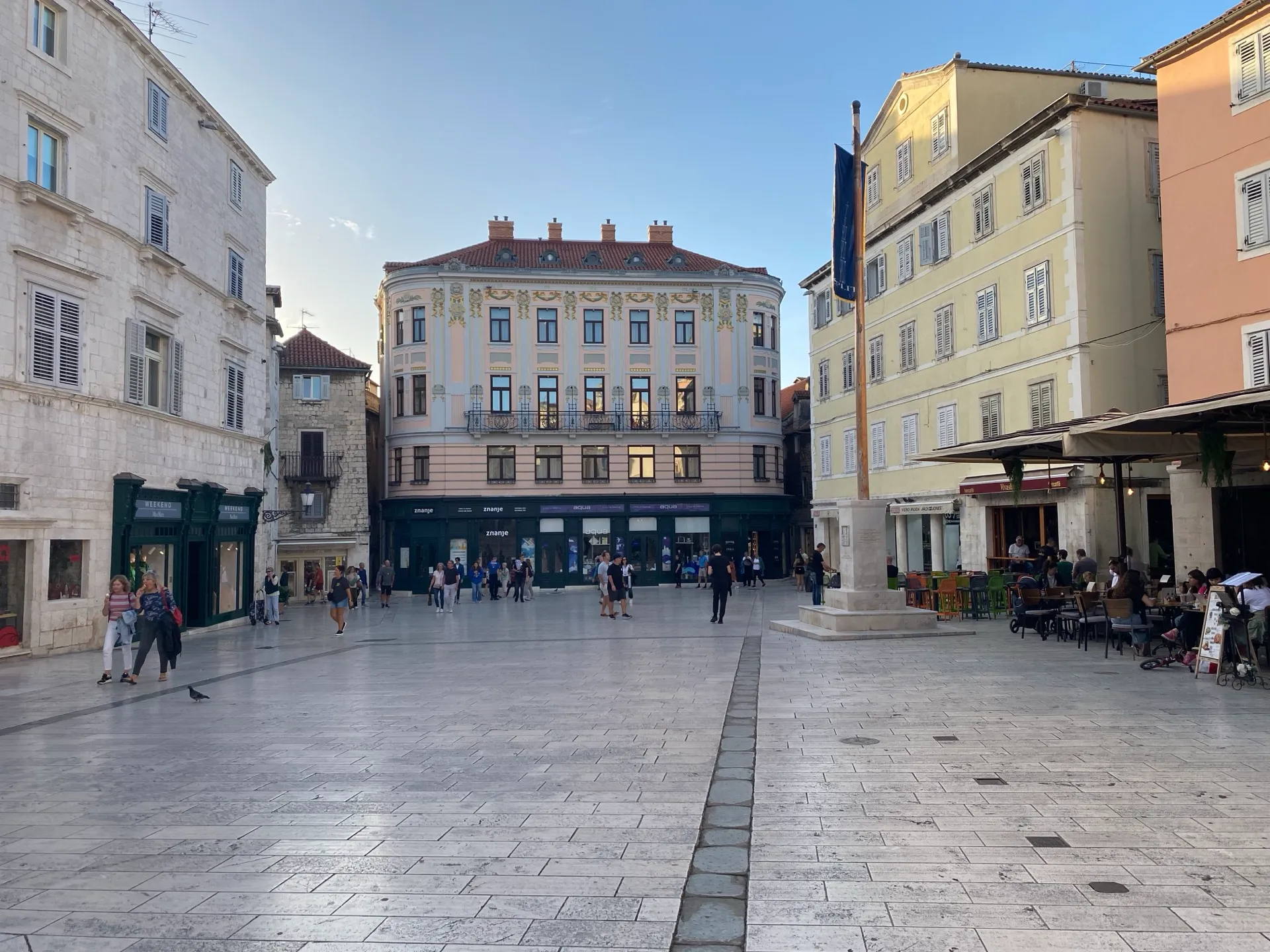

Šibenik’s historic centre is compact enough for a short visit but layered enough to reward slow walking. In two or three hours, you can move from the lively pedestrian centre into stone lanes, reach the Cathedral of St James and its Renaissance square, then climb toward a view over the channel. This route is not a complete guide to every fortress, museum and neighbourhood. It is a focused first walk through the part of Šibenik that our own photographs document well.
The defining sight is the UNESCO-listed Cathedral of St James. Yet the pleasure of the route comes from the approach: pale stone underfoot, arches that frame the next square, stairways between old houses and sudden changes between busy public spaces and quiet lanes.
Quick route at a glance
Allow two to three hours for an unhurried old-town walk and the cathedral exterior. Add time if you enter the cathedral, visit the Civitas Sacra interpretation centre or continue to a fortress.
A simple sequence is:
- begin in the main pedestrian centre;
- enter the stone lanes of the old town;
- reach Trg Republike Hrvatske;
- examine the cathedral exterior and historic Town Hall;
- continue uphill through steps and lanes;
- finish at an elevated view and descend by a different route.
The route is short on a map, but Šibenik is not flat. Heat, polished stone and repeated steps matter more than distance.
Start in the pedestrian centre
The broad pedestrian spaces around the centre are the easiest place to orient yourself. Cafés and shops make this section feel more modern and open than the medieval lanes ahead. It is also a useful meeting point if your group separates.
Do not rush directly to the cathedral. The transition is part of the experience. As the streets narrow, newer shopfronts give way to stone façades, green shutters, small arches and stairways. Looking back is often as rewarding as looking forward because the route repeatedly frames the city in layers.
Our archive begins with a wide pedestrian square and then moves toward the cathedral quarter. That is the honest strength of this article: it follows a real compact walk rather than pretending to cover all of Šibenik in one visit.
Enter the stone lanes
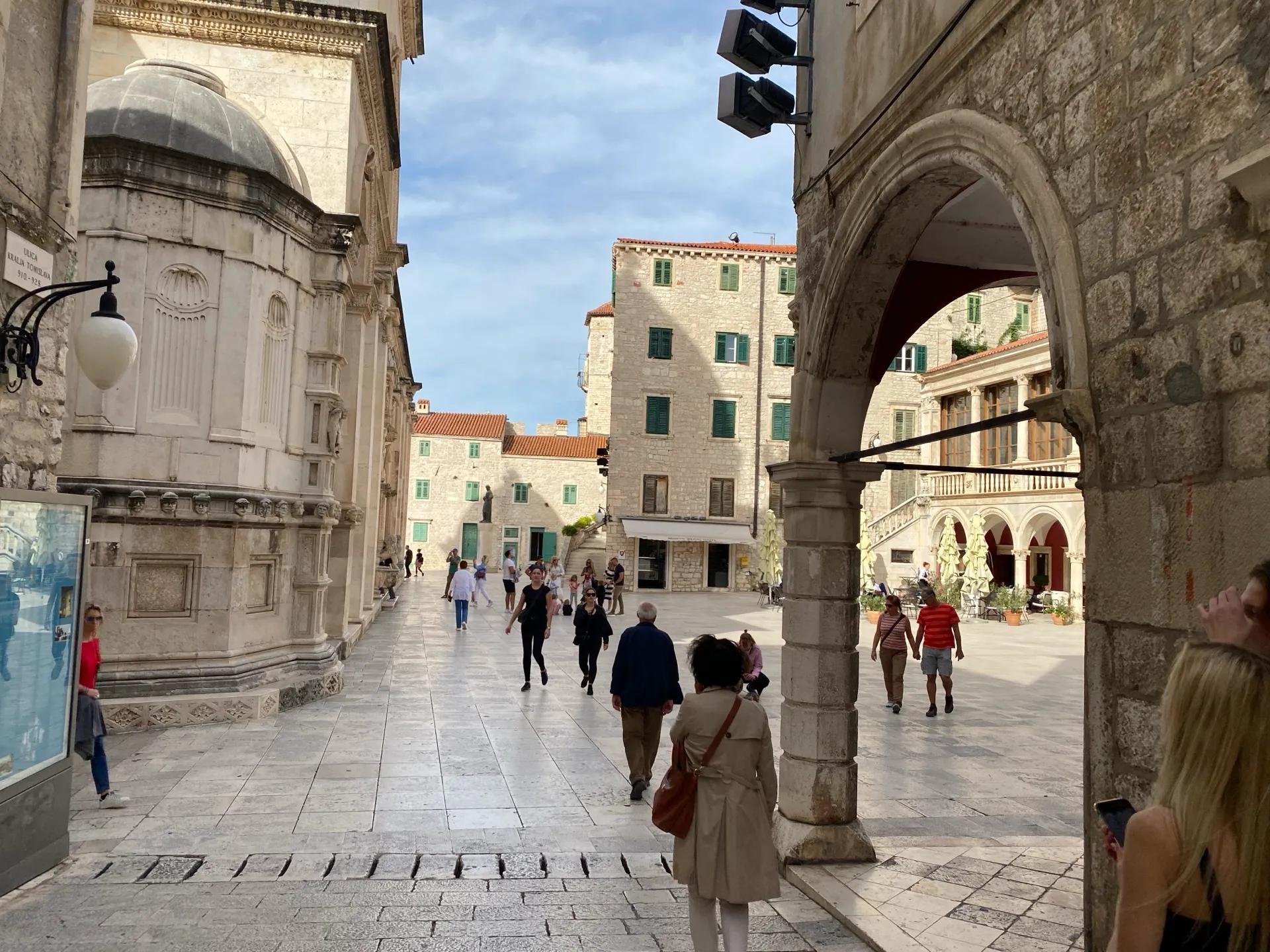
Šibenik’s old town invites wandering, but it helps to keep the cathedral as the first fixed point. Side lanes are tempting and usually reconnect, yet the height changes can turn a small detour into extra stairs.
Notice the surfaces. Smooth limestone can become slippery after rain, and hard soles are tiring on uneven steps. In summer, early morning and late afternoon are more comfortable than the hottest part of the day. Shade shifts quickly between the tall stone walls.
This is also a lived-in centre, not an open-air set. Keep voices low in residential lanes, do not block doorways for photographs and give residents room on narrow steps.
Trg Republike Hrvatske: the architectural heart
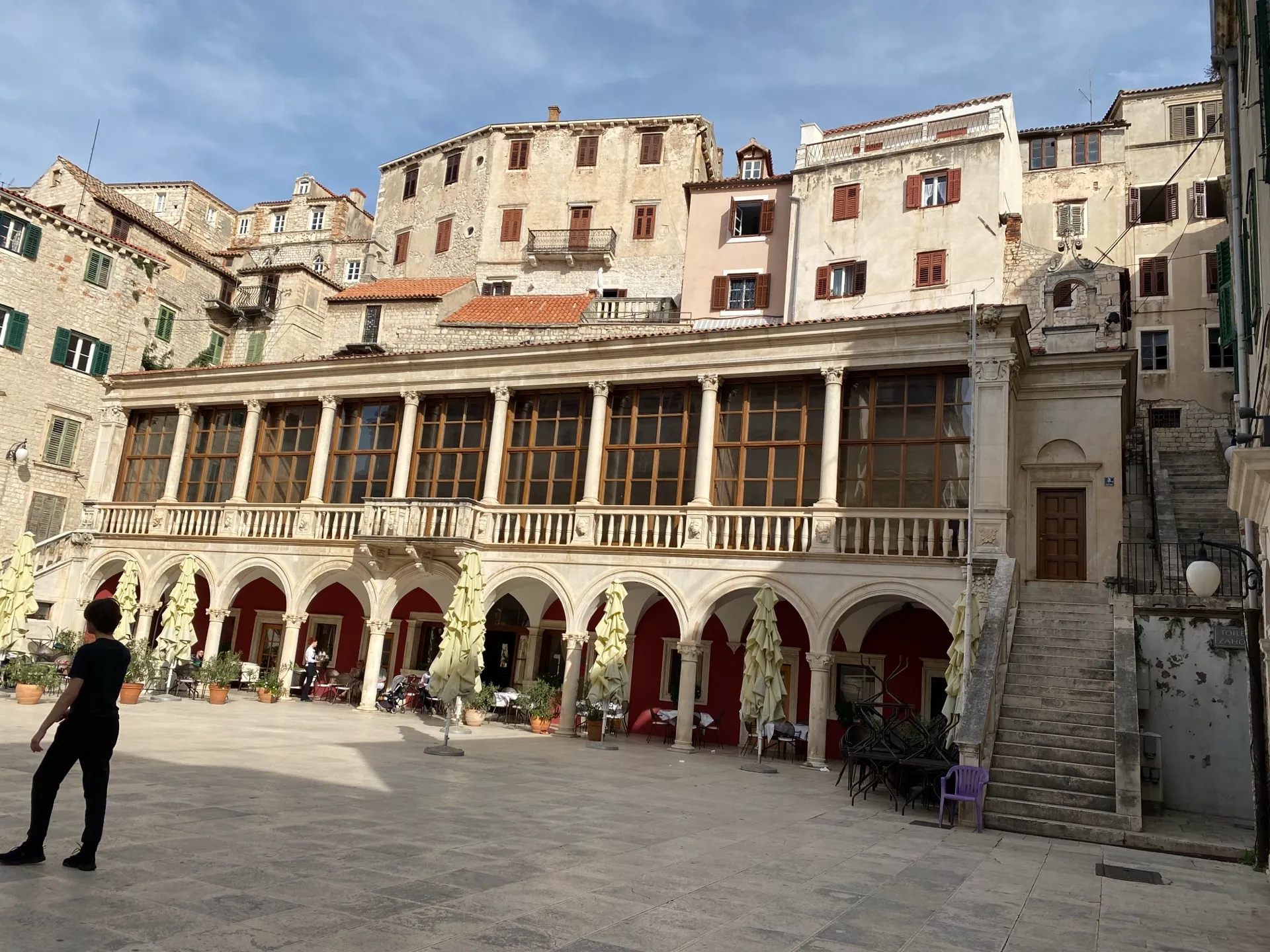
The route opens dramatically onto Trg Republike Hrvatske. The Cathedral of St James occupies one side, while the historic Town Hall faces it with a long Renaissance loggia. Cafés use parts of the square, but its scale still allows the two stone façades to be read together.
The square works best when you cross it more than once. First take in the overall composition. Then move under an arch or toward a corner to see how the cathedral changes with the angle. Our photographs show this especially well: the apse appears beside a stone arch, while the Town Hall rises in front of closely packed houses and steep steps.
Allow time here even if you do not enter any building. The square explains how Šibenik’s civic and religious life occupied the same compact urban stage.
Cathedral of St James: what makes it exceptional
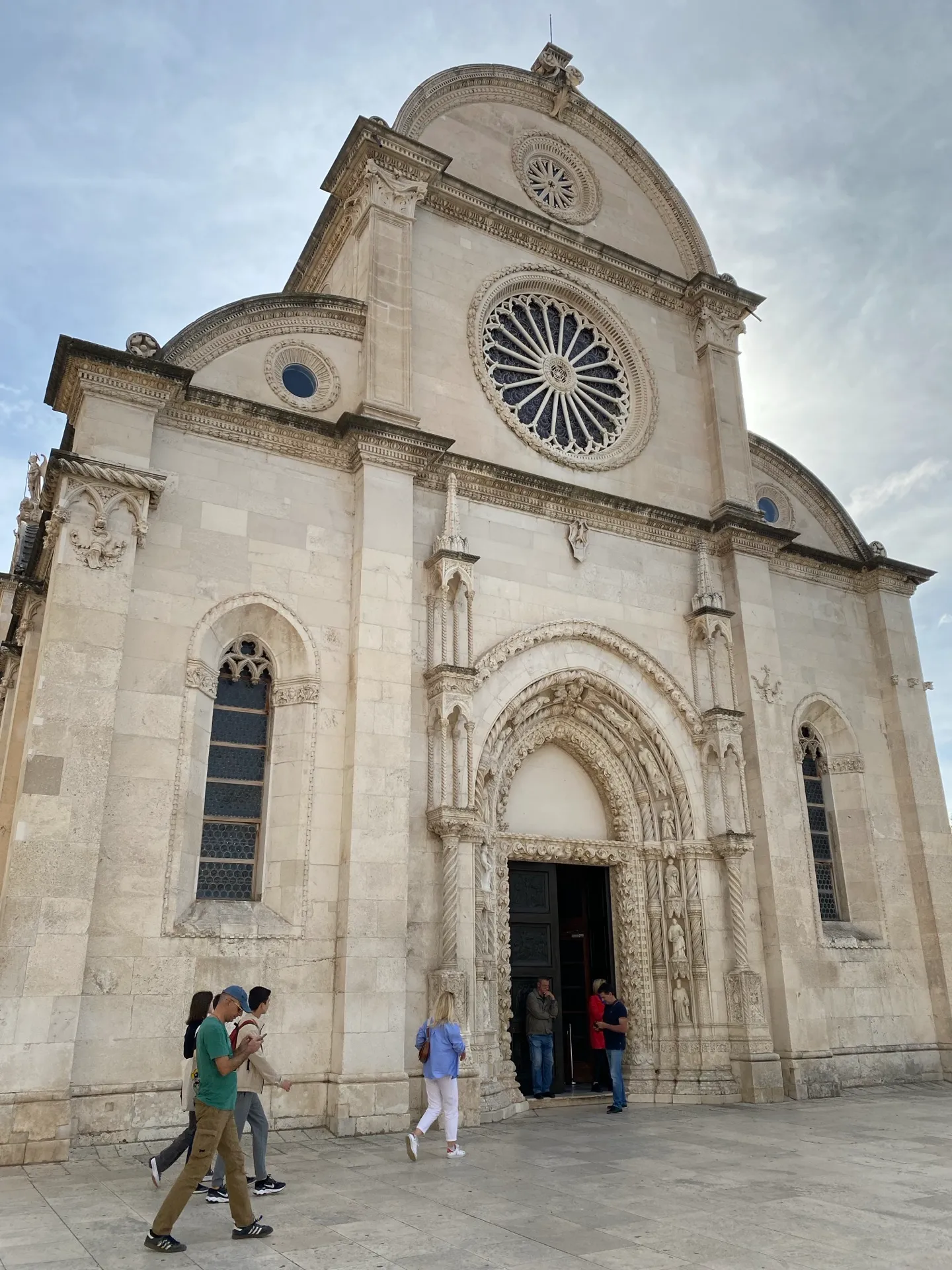
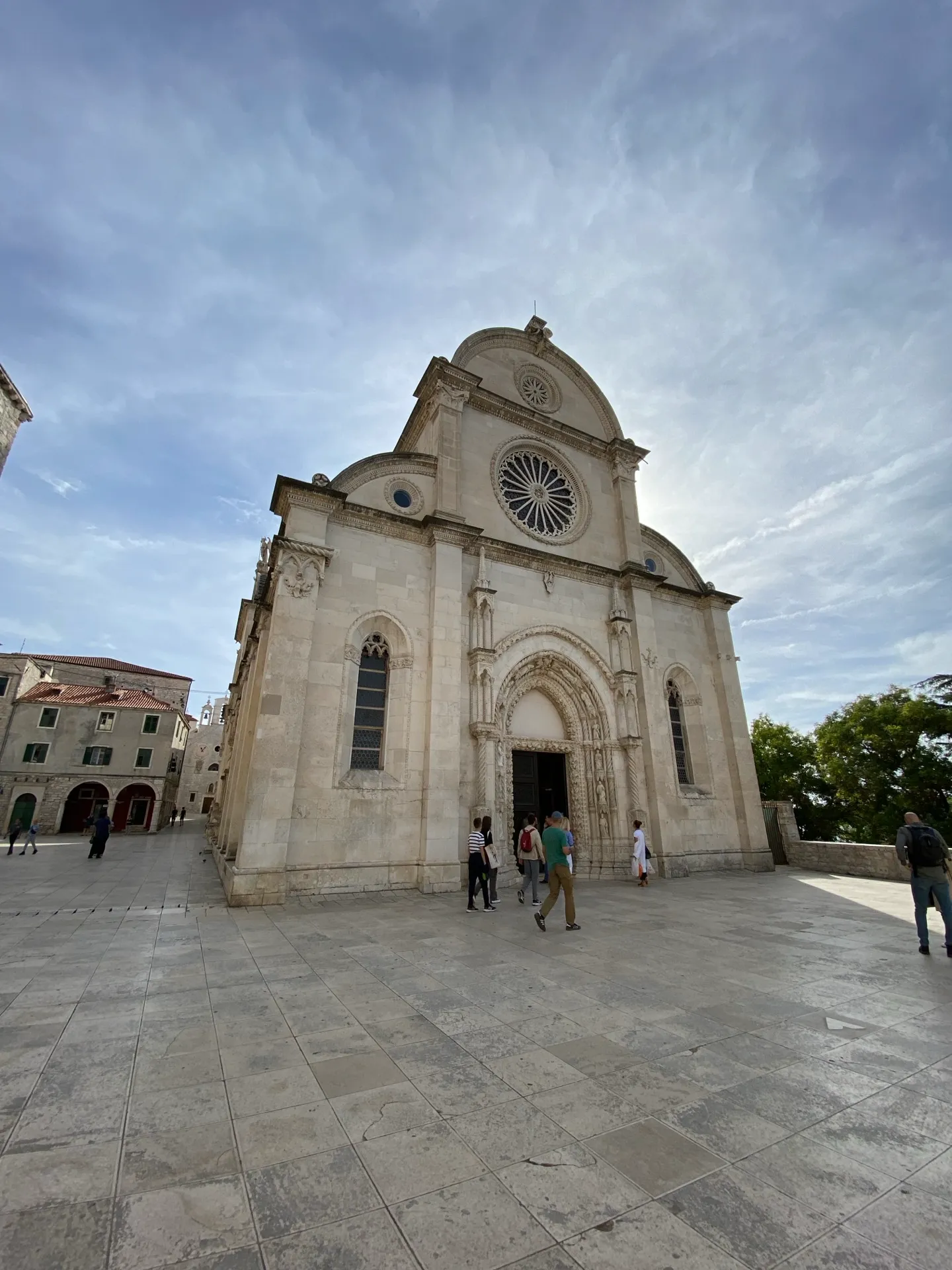
Construction of the cathedral took place from 1431 to 1535. UNESCO describes it as an exceptional fusion of Gothic and Renaissance architecture and emphasises the exchange of ideas between Northern Italy, Dalmatia and Tuscany. Francesco di Giacomo, Juraj Dalmatinac and Nikola Firentinac were the principal architects connected with its development.
Its most remarkable technical fact is easy to miss if you only photograph the façade: the cathedral was constructed entirely from stone, including its vaulting and dome, with distinctive methods of assembling large stone elements. The consistency of the material gives the exterior and interior unusual unity.
Begin with the western façade and its richly carved portal. Step back far enough to see the rose window and the curved upper profile, then approach again for the smaller figures and patterns around the doorway.
Next walk toward the apses. The famous frieze of 71 sculpted heads runs around the exterior. The faces differ in age, expression and appearance, and their exact identities remain uncertain. They are not just a decorative footnote; they make the building feel connected to real human observation.
The cathedral entered the UNESCO World Heritage List in 2000. That recognition belongs to this specific monument, not to every street in the old town, so describe the distinction accurately.
Should you go inside?
If the cathedral is open outside a service, the interior adds an important second reading of the stone construction. However, it remains an active place of worship. Visiting hours, admission arrangements and access can change with the season, religious services and conservation work.
Check the current official information on the day of your visit. Dress respectfully, keep quiet, avoid photographing people at prayer and obey any restrictions on photography. An old online price or schedule is not reliable enough for planning.
The nearby Civitas Sacra interpretation centre can provide more context about the cathedral’s construction and history. Treat it as an optional extension and verify its current hours separately.
Continue uphill for a panorama
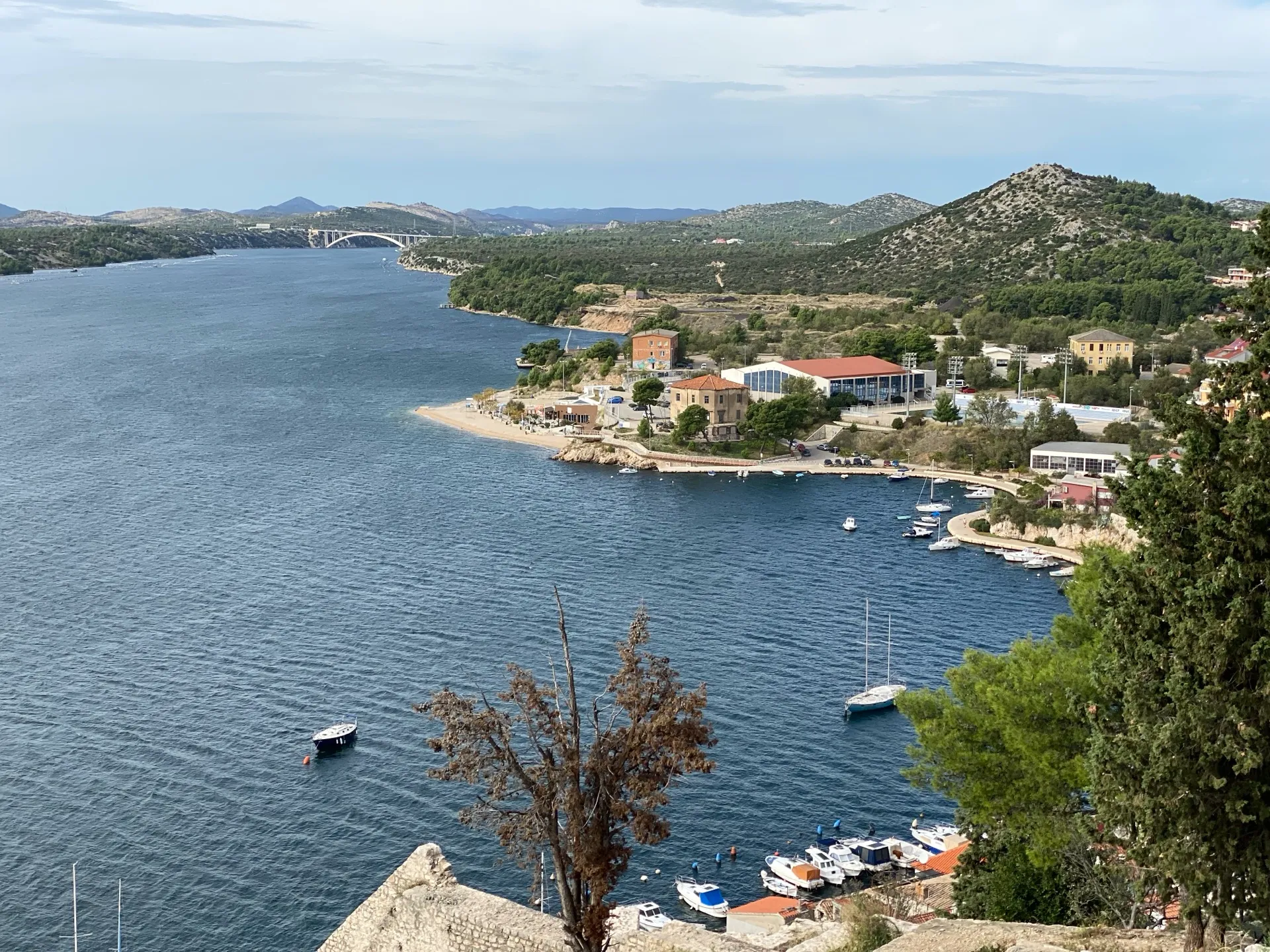
After the square, follow the rising lanes rather than immediately returning to the waterfront. The upper parts of the historic centre replace formal façades with steps, rougher walls and more intimate passages. This section reveals the city’s topography.
Our archive includes a broad view across the Šibenik Channel, with boats, the opposite shore and the bridge in the distance. We are deliberately not naming the exact viewpoint until it is confirmed. The practical point remains useful: gaining height above the old town changes the visit from a sequence of monuments into an understanding of Šibenik’s relationship with the water and surrounding karst landscape.
If you continue to a fortress, check its separate ticket and opening hours. A fortress visit is an additional attraction, not automatically included in this short old-town route.
A small piece of city history
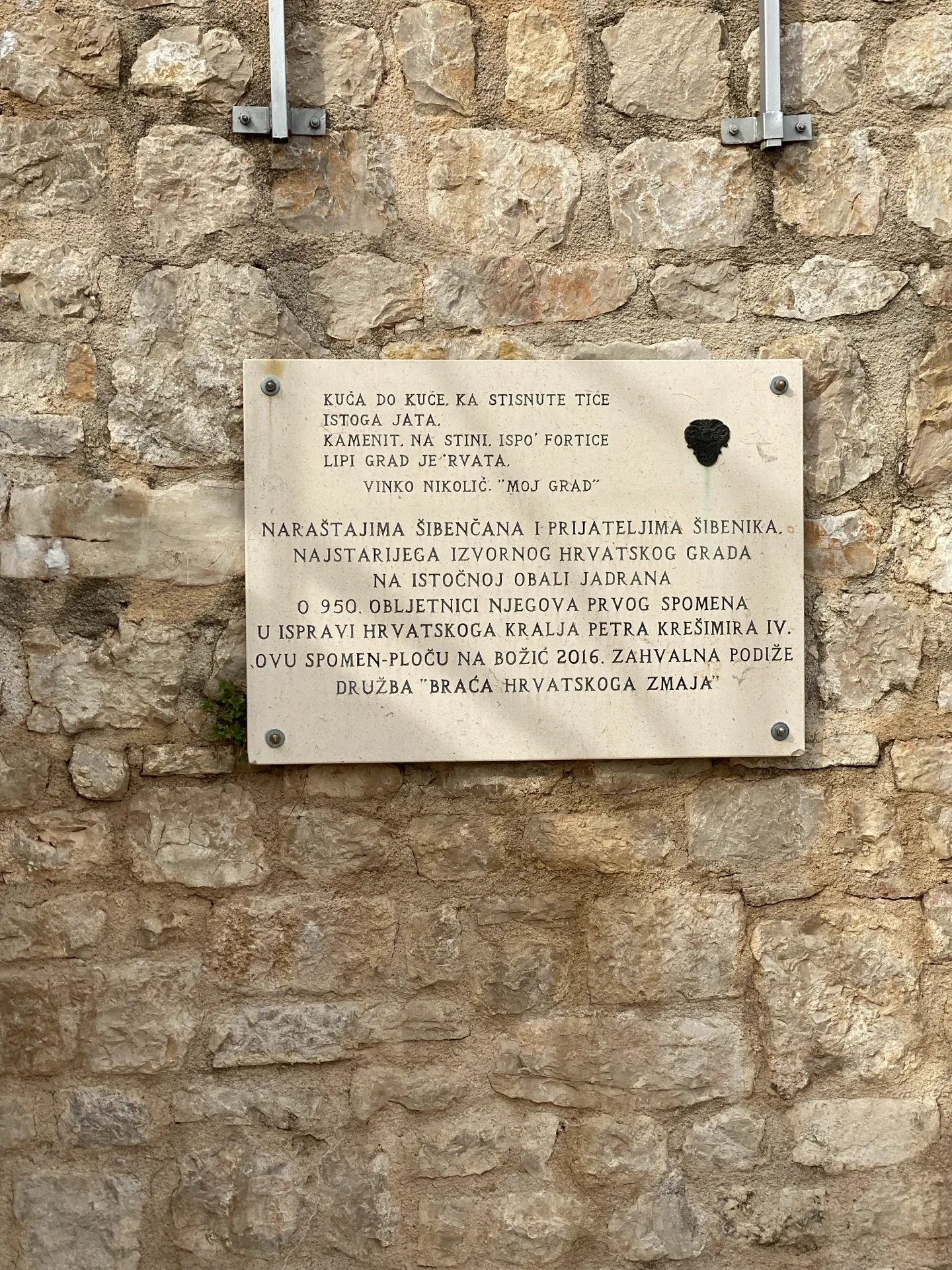
One archive photograph shows a plaque installed in 2016 for the 950th anniversary of Šibenik’s first written mention. It refers to a 1066 document of Croatian King Petar Krešimir IV and describes Šibenik as the oldest native Croatian city on the eastern Adriatic coast.
The plaque is a useful reminder that the cathedral, although the star attraction, represents only one period in a much longer city story. Read such markers where you find them, but keep the walk visually simple: square, cathedral, lanes and view.
Practical advice
Wear shoes with grip. The old centre includes polished stone, uneven surfaces and many steps. A pushchair is possible in some lower streets but awkward on the full uphill route. Wheelchair users should plan a lower, step-minimised route and verify accessible entrances directly with individual attractions.
Carry water in warm weather. The lanes provide intermittent shade, while the cathedral square and viewpoints can be exposed. Early morning offers cooler walking and cleaner architectural photographs; late afternoon brings warmer light but more activity around restaurants.
Do not assume that the closest parking is the easiest option. The historic core is pedestrianised, and traffic arrangements and prices can change. Choose a current public car park outside the lanes and accept a short walk rather than circling narrow approaches.
For families, turn the route into a visual search: arches, carved faces, rose window, green shutters and boats from above. Children usually respond better to these details than to a long architectural lecture.
Honest verdict
Šibenik Old Town works very well as a half-day stop because the central experience is concentrated. The Cathedral of St James is genuinely exceptional, but the route feels complete only when you include the square, the Town Hall, the narrow stone approach and at least one elevated view.
The limitations are physical rather than conceptual: steps, heat and slippery stone can slow the walk. Our present archive is strong enough for this focused route, but not for a definitive guide to all of Šibenik. Fortresses, the waterfront, parking and a wider city itinerary deserve separate research and additional photographs.
Frequently asked questions
How long do I need for Šibenik Old Town?
Allow about two to three hours for a relaxed historic-centre walk and the cathedral exterior. Add time for interiors, interpretation centre or fortress visits.
Is the Cathedral of St James a UNESCO site?
Yes. The cathedral was inscribed on the UNESCO World Heritage List in 2000.
Is Šibenik Old Town flat?
No. The lower centre is easier, but many lanes climb through steps and sloping stone surfaces.
Can I visit the cathedral during a service?
It is an active place of worship. Avoid sightseeing during services unless the church explicitly allows it, and always follow on-site instructions.
Is this a complete Šibenik guide?
No. It is a focused route through the historic centre. A full city guide should also cover the fortresses, waterfront, transport and other neighbourhoods.
Last updated: 10 August 2026.